
edmonia lewis
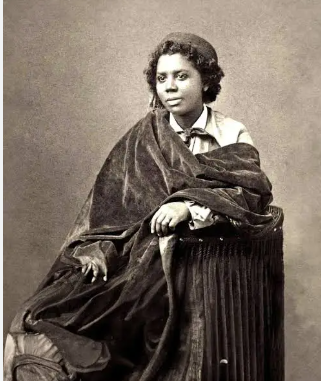
Edmonia Lewis was an American artist of mixed African American and Native American heritage, born in New York in 1844. As a young woman, she attended a Baptist abolitionist school, and later attended Oberlin College in Ohio, where she studied art. She was not able to complete her degree due to a situation where she was accused of poisoning two of her White classmates, although the charges were later dismissed due to a lack of evidence. After this, she was accused of stealing art supplies and faced more prejudice and discrimination on campus. Close to graduating, Edmonia was blocked from being able to register for her last term, and was forced to leave the school. (In 2022, Oberlin College awarded her a degree post-humorously.)
After college, Lewis later moved to Boston to pursue a career as a sculptor, and for a time, she studied under an esteemed marble bust sculptor, Edward Augustus Bracket (1818-1908). Bracket offered her guidance and criticism as she worked in clay before she handled carving in marble. In 1864, Lewis opened her own studio to the public, holding her first solo exhibition in the same year. Much of her work was inspired by abolitionist leaders and her subject matter focused on human rights.
Her success as a sculptor in Boston financed her voyage to Rome in 1866, before moving to Paris, and later London until her death in 1907. Lewis stated in an 1878 article by the New York Times that she was “practically driven to Rome in order to obtain the opportunities for art culture, and to find a social atmosphere where I was not constantly reminded of my color. The land of liberty had no room for a colored sculptor.” In Rome, Lewis was able to thrive physically, artistically, and spiritually, which is reflected in much of her work. Because of the less severe racism in Europe, Lewis felt a freedom that she had not experienced in the United States, which led her to become better known in the international art world.
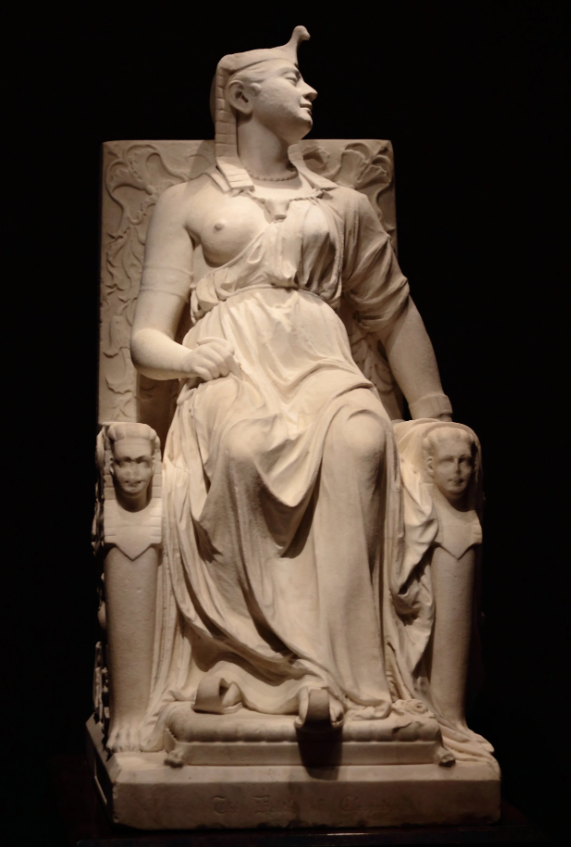
Being in Italy in the late nineteenth century surrounded by Classical art inspired her predilection towards Neoclassicism. Although she did not create most of her work in America, her ideas on incorporating African iconography as an American-born artist remain important. In 1876, Lewis sculpted The Death of Cleopatra, a portrayal of the Egyptian ruler after a snake’s venom had taken her life. Cleopatra in Lewis’ sculpture has taken control of her own fate, an African icon who is electively choosing to end her life, making room for a rebirth, and an opportunity to redefine a cultural identity.
If this African icon represents Mother Africa, she has let go of her progenies as they embrace a new coast, a new mother land. These early works help to set the stage for Black artists of the Harlem Renaissance by bringing African symbolism and iconography back into the artistic conversation of cultural identity.
References:
Buick, Kirsten Pai. Child of the Fire: Mary Edmonia Lewis and the Problem of Art History's Black and Indian Subject. Durham, NC: Duke University Press, 2010.
Richardson, Marylin. “Lewis, Edmonia (1840-after 1909), sculptor.” American National Biography (2000) https://doi.org/10.1093/anb/9780198606697.article.1701145.
“Seeking Equality Abroad: Why Miss Edmonia Lewis, The Colored Sculptor, Returns to Rome; Her Early Life and Struggles.” New York Times. December 29, 1878. https://www.nytimes.com/1878/12/29/archives/seeking-equality-abroad-why-miss-edmonia-lewis-the-colored-sculptor.html.
Smithsonian American Art Museum. “The Death of Cleopatra.” Accessed October 1, 2023. https://americanart.si.edu/artwork/death-cleopatra-33878.
Smithsonian American Art Museum. “Edmonia Lewis.” Accessed October 1, 2023. https://americanart.si.edu/artist/edmonia-lewis-2914.